
Some Port boxes have a written enclosure, describing the product, describing conditions, etc.
These enclosures are the sort of thing that geeks should gather. This thread is to hold such enclosures. Please include:
• What box?
• A picture. If possible, scale to be phpbb sized (so ⪅1k pixels across), but make that a link to a higher-resolution image.
• The text — yes, it can be a hassle to type. Nonetheless, it facilitates searching and copy-pasting, so please do.
• Other juicy info.
Port-box enclosures
Re: Port-box enclosures
The following is from an OWC of a dozen Warre 2000.
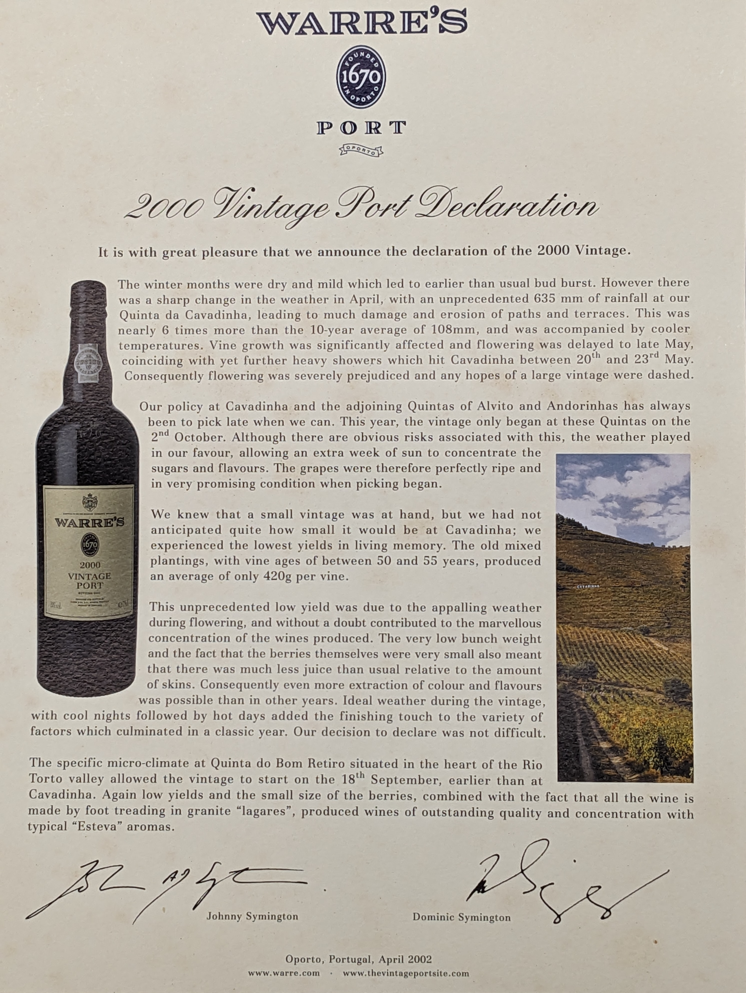
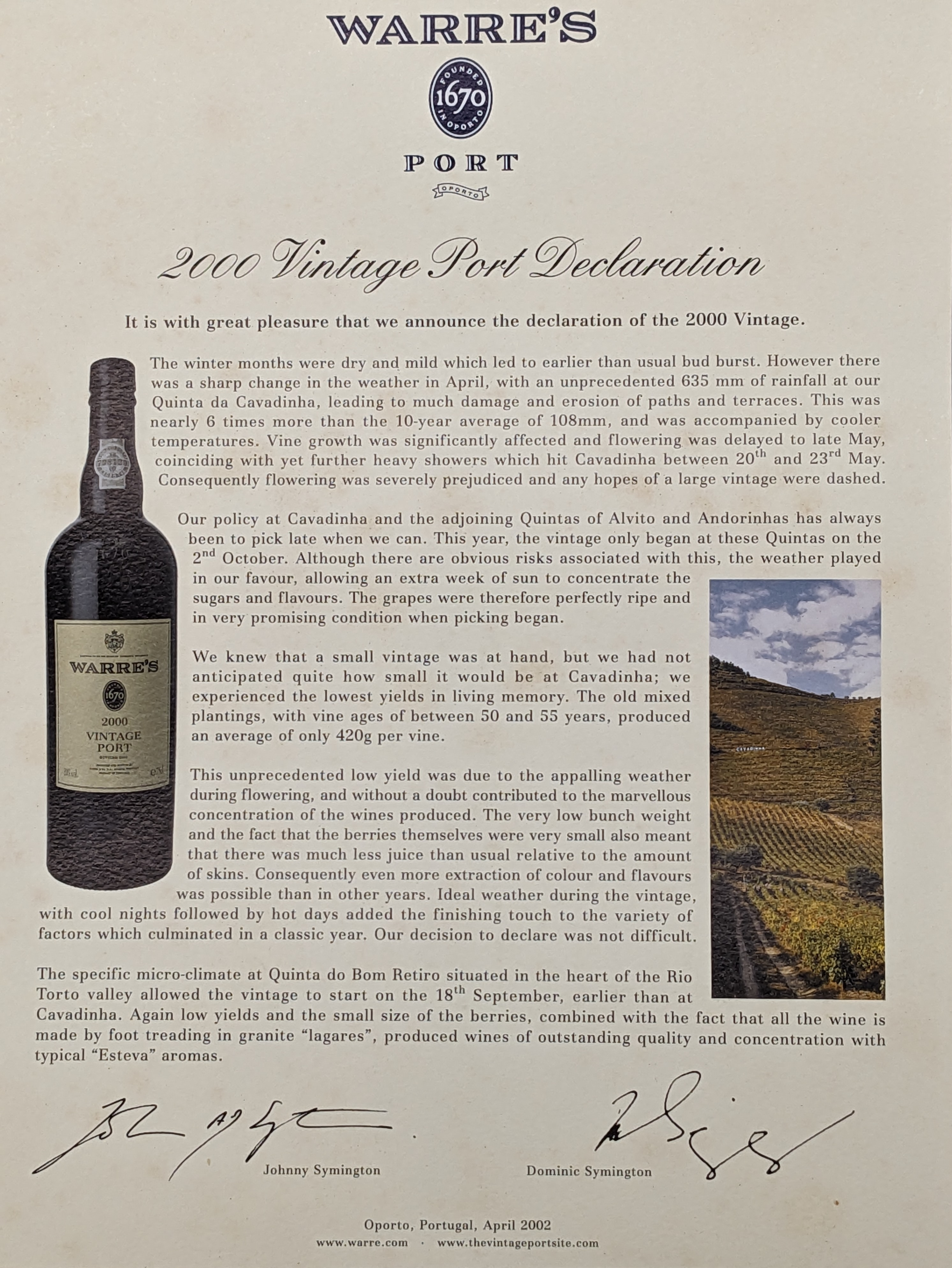
Johnny Symington and Dominic Symington, in a letter in the OWC of Warre 2000, wrote:Warre’s Port
2000 Vintage Port Declaration
It is with great pleasure that we announce the declaration of the 2000 Vintage.
The winter months were dry and mild which led to earlier than usual bud burst. However there was a sharp change in the weather in April, with an unprecedented 635 mm of rainfall at our Quinta da Cavadinha. leading to much damage and erosion of paths and terraces. This was nearly 6 times more than the 10-year average of 108mm, and was accompanied by cooler temperatures. Vine growth was significantly affected and flowering was delayed to late May, coinciding with yet further heavy showers which hit Cavadinha between 20th and 23rd May. Consequently flowering was severely prejudiced and any hopes of a large vintage were dashed.
Our policy at Cavadinha and the adjoining Quintas of Alvito and Andorinhas has always been to pick late when we can. This year, the vintage only began at these Quintas on the 2nd October. Although there are obvious risks associated with this, the weather played in our favour, allowing an extra week of sun to concentrate the sugars and flavours. The grapes were therefore perfectly ripe and in very promising condition when picking began.
We knew that a small vintage was at hand, but we had not anticipated quite how small it would be at Cavadinha; we experienced the lowest yields in living memory. The old mixed plantings, with vine ages of between 50 and 55 years, produced an average of only 420g per vine.
This unprecedented low yield was due to the appalling weather during flowering, and without a doubt contributed to the marvellous concentration of the wines produced. The very low bunch weight and the fact that the berries themselves were very small also meant that there was much less juice than usual relative to the amount of skins. Consequently even more extraction of colour and flavours was possible than in other years. Ideal weather during the vintage, with cool nights followed by hot days added the finishing touch to the variety of factors which culminated in a classic year. Our decision to declare was not difficult.
The specific micro-climate at Quinta do Bom Retiro situated in the heart of the Rio Torto valley allowed the vintage to start on the 18th September, earlier than at Cavadinha. Again low yields and the small size of the berries, combined with the fact that all the wine is made by foot treading in granite “lagares”, produced wines of outstanding quality and concentration with typical “Esteva” aromas.
Johnny Symington
Dominic Symington
Oporto, Portugal, April 2002
www.warre.com www.thevintageportsite.com
Re: Port-box enclosures
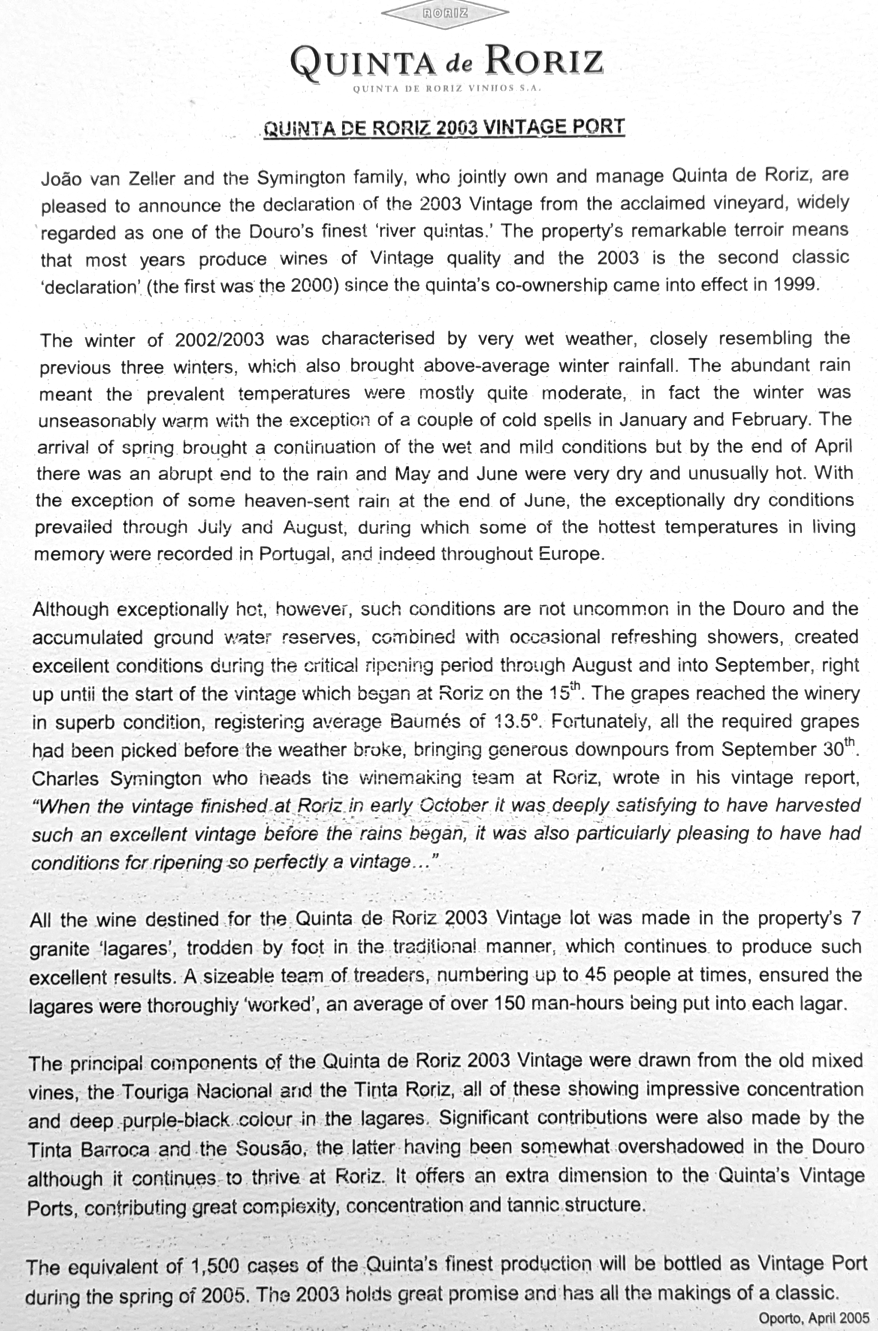

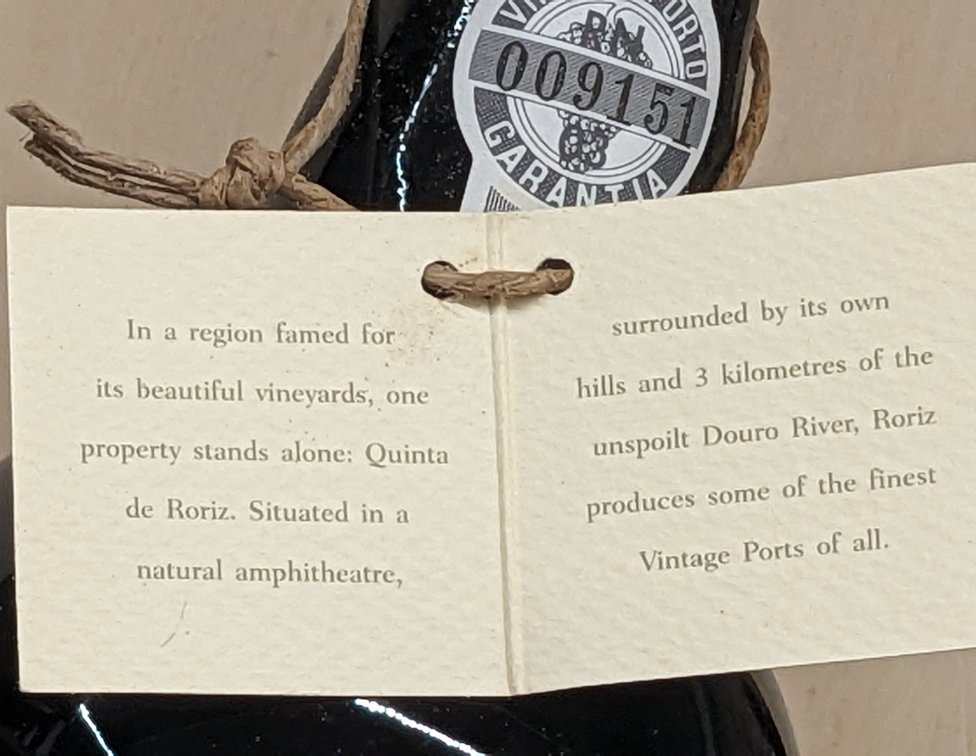
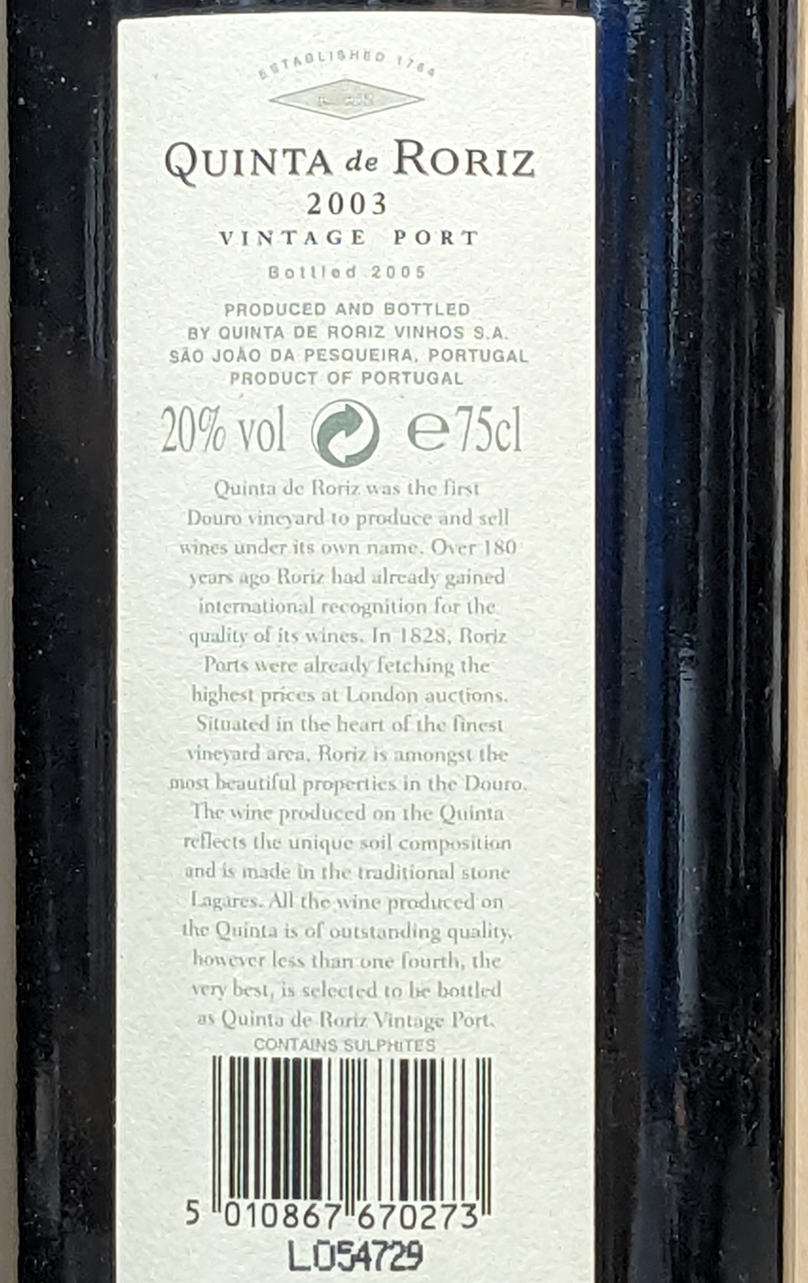
jdaw1 wrote: ↑23:32 Fri 14 Mar 2025João van Zeller and the Symington family, in an A4 enclosure in the Rr03 OWC, wrote:QUINTA DE RORIZ 2003 VINTAGE PORT
João van Zeller and the Symington family, who jointly own and manage Quinta de Roriz, are pleased to announce the declaration of the 2003 Vintage from the acclaimed vineyard, widely regarded as one of the Douro’s finest ‘river quintas.’ The property’s remarkable terroir means that most years produce wines of Vintage quality and the 2003 is the second classic ‘declaration’ (the first was the 2000) since the quinta’s co-ownership came into effect in 1999.
The winter of 2002/2003 was characterised by very wet weather, closely resembling the previous three winters, which also brought above-average winter rainfall. The abundant rain meant the prevalent temperatures were mostly quite moderate, in fact the winter was unseasonably warm with the exception of a couple of cold spells in January and February. The arrival of spring brought a continuation of the wet and mild conditions but by the end of April there was an abrupt end to the rain and May and June were very dry and unusually hot. With the exception of some heaven-sent rain at the end of June, the exceptionally dry conditions prevailed through July and August, during which some of the hottest temperatures in living memory were recorded in Portugal, and indeed throughout Europe.
Although exceptionally hot, however, such conditions are not uncommon in the Douro and the accumulated ground water reserves, combined with occasional refreshing showers, created excellent conditions during the critical ripening period through August and into September, right up until the start of the vintage which began at Roriz on the 15th. The grapes reached the winery in superb condition, registering average Baumés of 13.5°. Fortunately, all the required grapes had been picked before the weather broke, bringing generous downpours from September 30th. Charles Symington who heads the winemaking team at Roriz, wrote in his vintage report, “When the vintage finished at Roriz in early October it was deeply satisfying to have harvested such an excellent vintage before the rains began, it was also particularly pleasing to have had conditions for ripening so perfectly a vintage…”
All the wine destined for the Quinta de Roriz 2003 Vintage lot was made in the property’s 7 granite ‘lagares’, trodden by foot in the traditional manner, which continues to produce such excellent results. A sizeable team of treaders, numbering up to 45 people at times, ensured the lagares were thoroughly ‘worked’, an average of over 150 man-hours being put into each lagar.
The principal components of the Quinta de Roriz 2003 Vintage were drawn from the old mixed vines, the Touriga Nacional and the Tinta Roriz, all of these showing impressive concentration and deep purple-black colour in the lagares. Significant contributions were also made by the Tinta Barroca and the Sousão, the latter having been somewhat overshadowed in the Douro although it continues to thrive at Roriz. It offers an extra dimension to the Quinta’s Vintage Ports, contributing great complexity, concentration and tannic structure.
The equivalent of 1,500 cases of the Quinta’s finest production will be bottled as Vintage Port during the spring of 2005. The 2003 holds great promise and has all the makings of a classic.
Oporto, April 2005
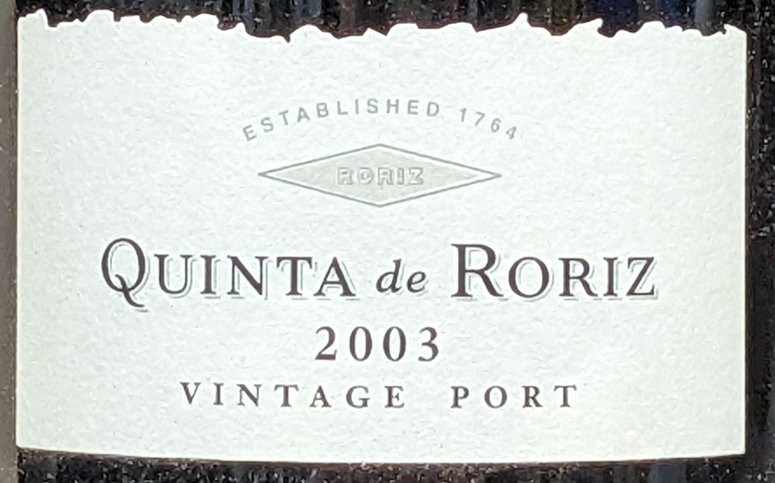
On the back label of the bottle of Rr03 was wrote:Quinta de Roriz was the first Douro vineyard to produce und sell wines under its own name. Over 180 years ago Roriz had already gained international recognition for the quality of its wines. In 1828, Roriz Ports were already fetching the highest prices at Landon auctions. Situated in the heart of the finest vineyard area, Roriz is amongst the most beautiful properties in the Douro. The wine produced on the Quinta reflects the unique soil composition and is made in the traditional stone Lagares. All the wine produced on the Quinta is of outstanding quality, however less than one fourth. the very best, is selected to be bottled as Quinta de Roriz Vintage Port.
On the neck tag of the Rr03 was wrote:In a region famed for its beautiful vineyards, one property stands alone: Quinta de Roriz. Situated in a natural amphitheatre, surrounded by its own hills and 3 kilometres of the unspoilt Douro River, Roriz produces some of the finest Vintage Ports of all.
-
Alex Bridgeman
- Croft 1945
- Posts: 16685
- Joined: 12:41 Mon 25 Jun 2007
- Location: Berkshire, UK
Re: Port-box enclosures
This is a great idea for a thread, and means I might now be able to throw away those irritating bits of paper I have no idea what to do with!
Top 2025: Quevedo 1972 Colheita, b.2024. Just as good as Niepoort 1900!
2026: DR Very Old White, Graham Stone Terraces 2011, Quevedo Branco 1986 b.2026
2026: DR Very Old White, Graham Stone Terraces 2011, Quevedo Branco 1986 b.2026
Re: Port-box enclosures
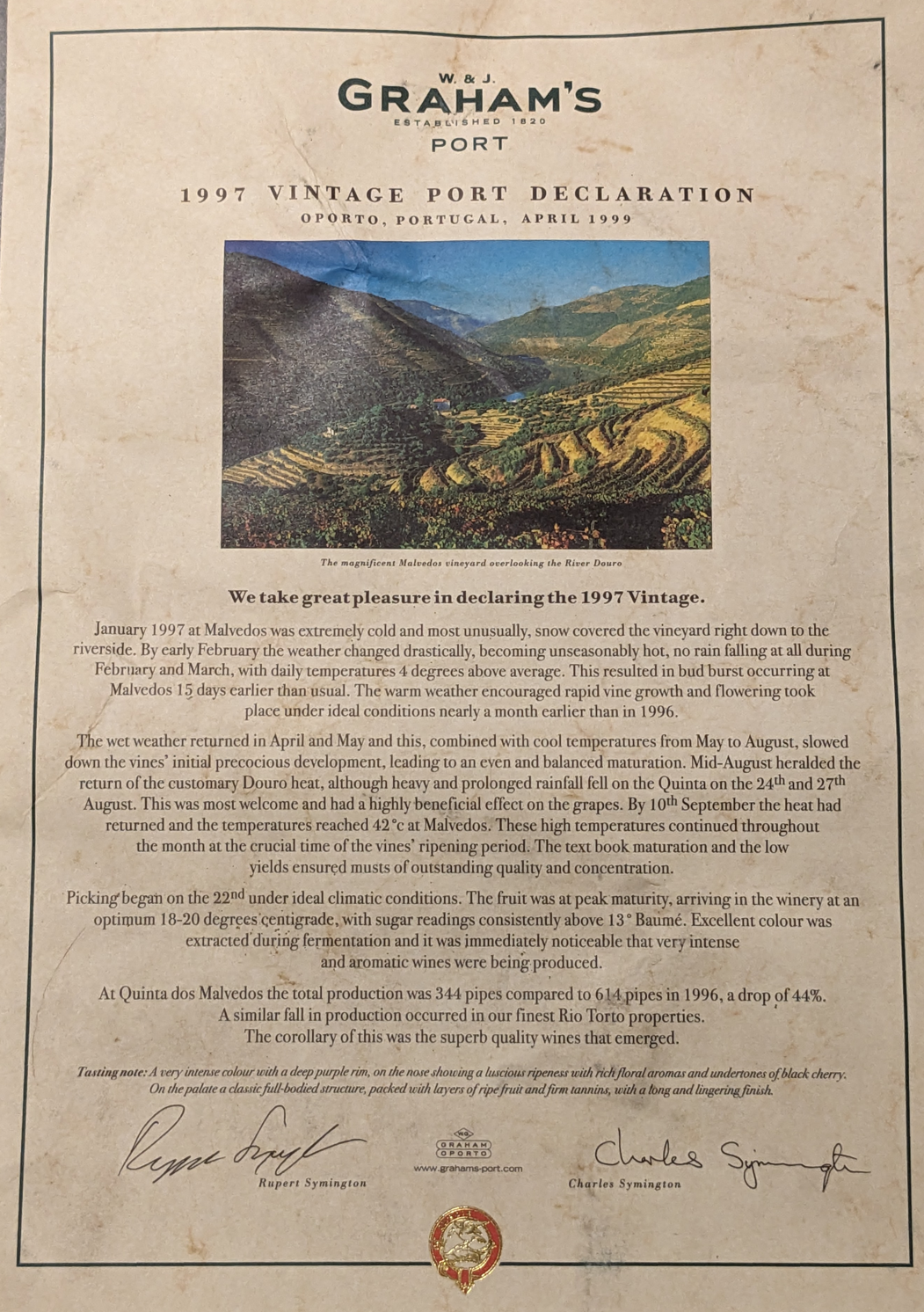
Enclosure in cardboard box of Graham 1997 wrote:Graham’s
1997 Vintage Port Declaration
Oporto, Portugal,April 1999
We take great pleasure in declaring the 1997 Vintage.
January 1997 at Malvedos was extremely cold and most unusually, snow covered the vineyard right down to the riverside. By early February the weather changed drastically, becoming unseasonably hot, no rain falling at all during February and March, with daily temperatures 4 degrees above average. This resulted in bud burst occurring at Malvedos 15 days earlier than usual. The warm weather encouraged rapid vine growth and flowering took place under ideal conditions nearly a month earlier than in 1996.
The wet weather returned in April and May and this, combined with cool temperatures from May to August, slowed down the vines’ initial precocious development, leading to an even and balanced maturation. Mid-August heralded the return of the customary Douro heat, although heavy and prolonged rainfall fell on the Quinta on the 24th and 27th August. This was most welcome and had a highly beneficial effect on the grapes. By 10th September the heat had returned and the temperatures reached 42°c at Malvedos. These high temperatures continued throughout the month at the crucial time of the vines’ ripening period. The text book maturation and the low yields ensured musts of outstanding quality and concentration.
Picking began on the 22nd under ideal climatic conditions. The fruit was at peak maturity, arriving in the winery at an optimum 18-20 degrees centigrade, with sugar readings consistently above 13° Baumé. Excellent colour was extracted during fermentation and it was immediately noticeable that very intense and aromatic wines were being produced.
At Quinta dos Malvedos the total production was 344 pipes compared to 614 pipes in 1996, a drop of 44%. A similar fall in production occurred in our finest Rio Torto properties. The corollary of this was the superb quality wines that emerged.
Tasting note: A very intense colour with a deep purple rim, on the nose showing a luscious ripeness with rich floral aromas and undertones of black cherry. On the palate a classic full-bodied structure, packed with layers of ripe fruit and firm tannins, with a long lingering finish.
Rupert Symington Charles Symington.
Re: Port-box enclosures
Wooden boxes of six of Vesuvio 1996, and of Vesuvio 1997, each contained identical pamphlets.
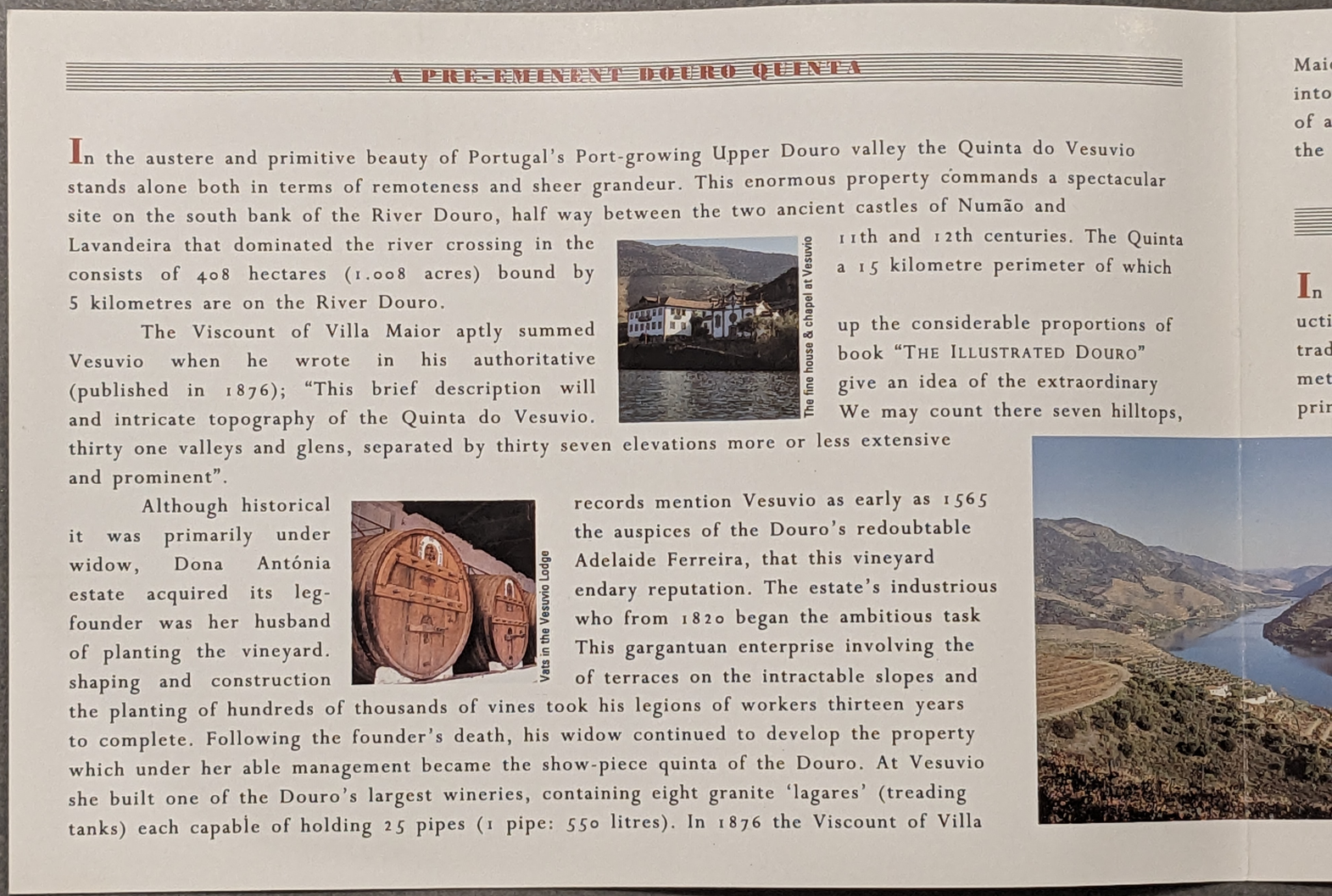
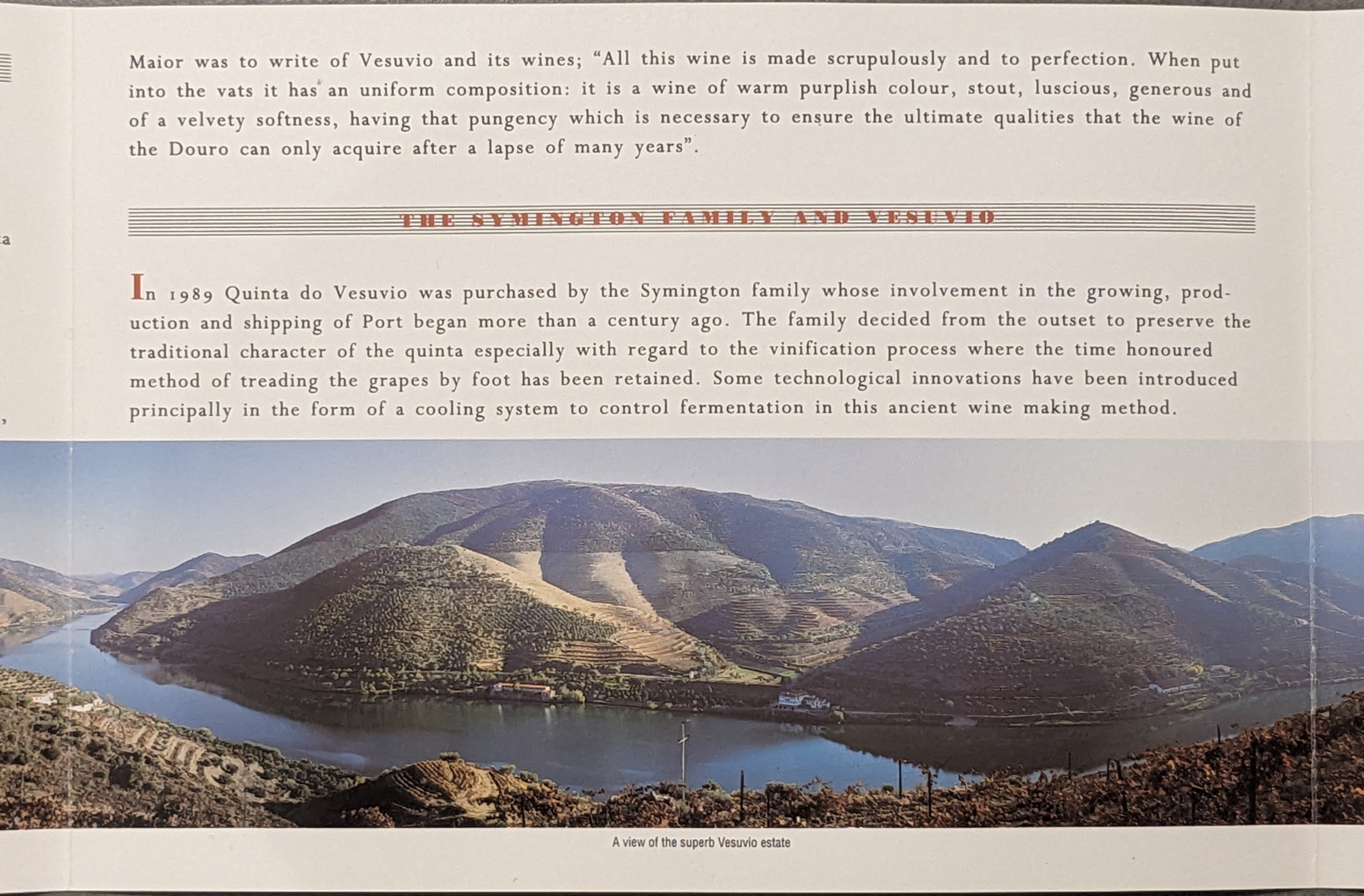
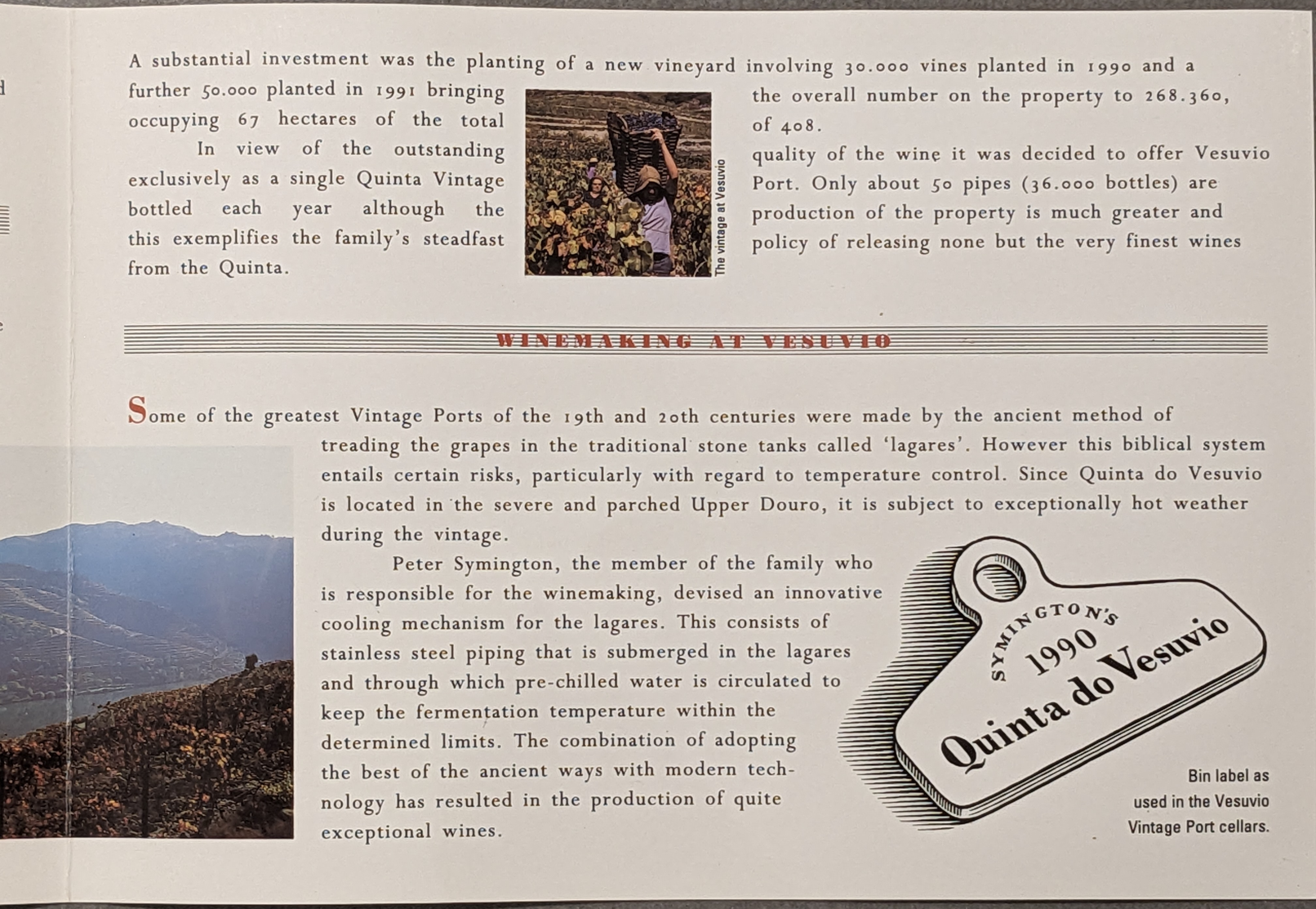
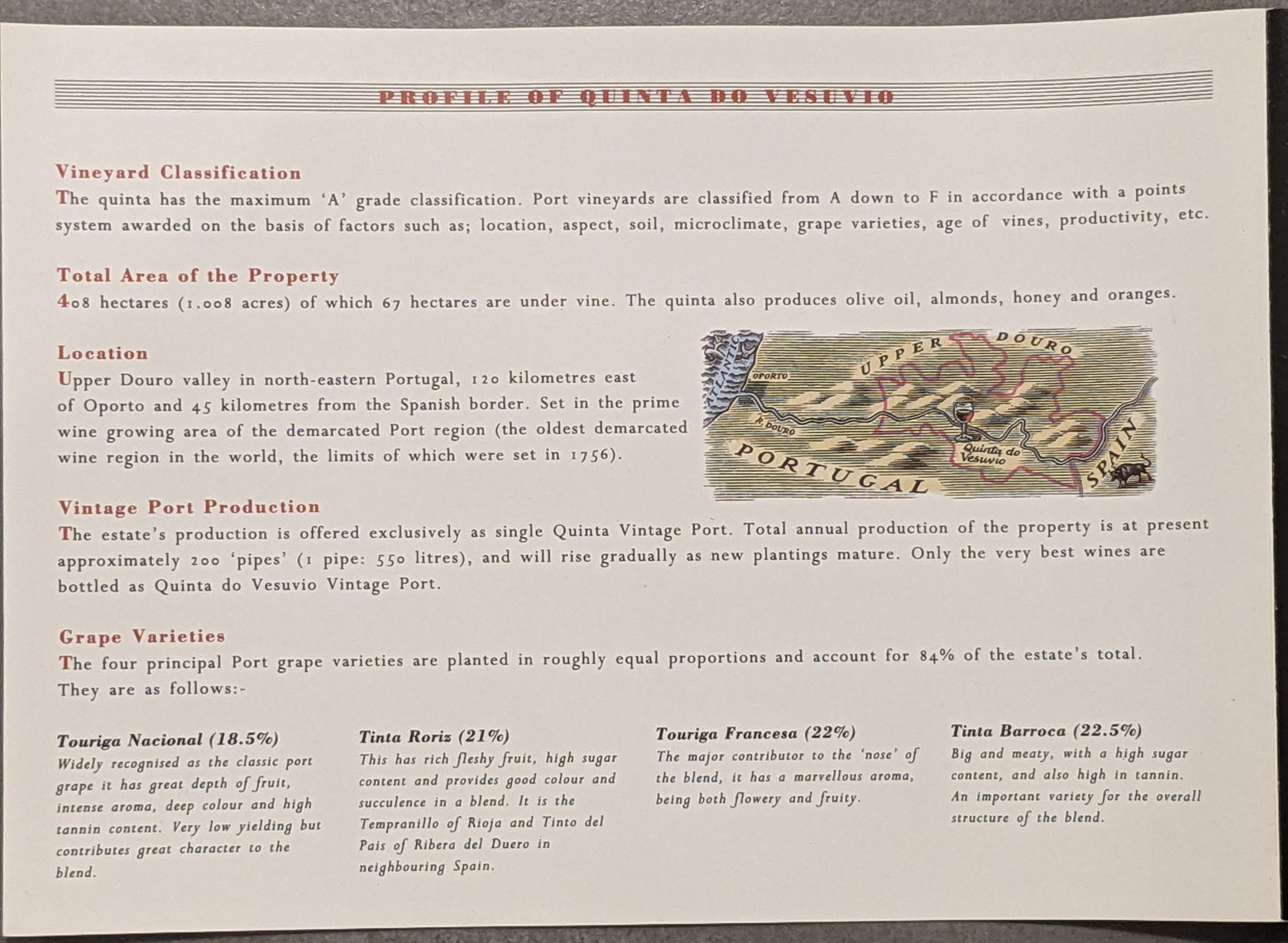
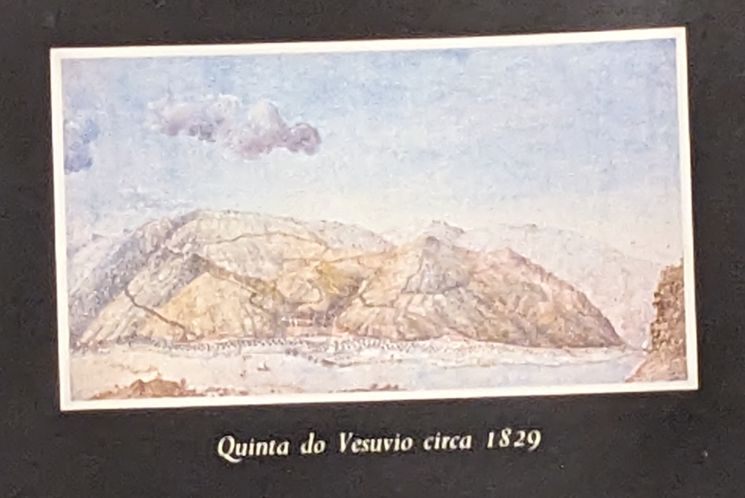
Vesuvio pamphlet, enclosed in 1996 and 1997 Vintages, wrote:A Pre-eminent Douro Quinta
In the austere and primitive beauty of Portugal’s Port-growing Upper Douro valley the Quinta do Vesuvio stands alone both in terms of remoteness and sheer grandeur. This enormous property commands a spectacular site on the south bank of the River Douro, half way between the two ancient castles of Numão and Lavandeira that dominated the river crossing in the 11th and 12th centuries. The Quinta consists of 408 hectares (1.008 acres) bound by a 15 kilometre perimeter of which 5 kilometres are on the River Douro.
The Viscount of Villa Maior aptly summed up the considerable proportions of Vesuvio when he wrote in his authoritative book “The Illustrated Douro” (published in 1876); “This brief description will give an idea of the extraordinary and intricate topography of the Quinta do Vesuvio. We may count there seven hilltops, thirty one valleys and glens, separated by thirty seven elevations more or less extensive and prominent”.
Although historical records mention Vesuvio as early as 1565 it was primarily under the auspices of the Douro’s redoubtable widow, Dona Antónia Adelaide Ferreira, that this vineyard estate acquired its legendary reputation. The estate’s industrious founder was her husband who from 1820 began the ambitious task of planting the vineyard. This gargantuan enterprise involving the shaping and construction of terraces on the intractable slopes and the planting of hundreds of thousands of vines took his legions of workers thirteen years to complete. Following the founder’s death, his widow continued to develop the property which under her able management became the show-piece quinta of the Douro. At Vesuvio she built one of the Douro’s largest wineries, containing eight granite ‘lagares’ (treading tanks) each capable of holding 25 pipes (i pipe: 550 litres). In 1876 the Viscount of Villa Maior was to write of Vesuvio and its wines; “All this wine is made scrupulously and to perfection. When put into the vats it has an uniform composition: it is a wine of warm purplish colour, stout, luscious, generous and of a velvety softness, having that pungency which is necessary to ensure the ultimate qualities that the wine of the Douro can only acquire after a lapse of many years”.
The Symington Family and Vesuvio
In 1989 Quinta do Vesuvio was purchased by the Symington family whose involvement in the growing, production and shipping of Port began more than a century ago. The family decided from the outset to preserve the traditional character of the quinta especially with regard to the vinification process where the time honoured method of treading the grapes by foot has been retained. Some technological innovations have been introduced principally in the form of a cooling system to control fermentation in this ancient wine making method.
A substantial investment was the planting of a new vineyard involving 30.000 vines planted in 1990 and a further 50.000 planted in 1991 bringing the overall number on the property to 268.360, occupying 67 hectares of the total of 408.
In view of the outstanding quality of the wine it was decided to offer Vesuvio exclusively as a single Quinta Vintage Port. Only about 50 pipes (36.000 bottles) are bottled each year although the production of the property is much greater and this exemplifies the family’s steadfast policy of releasing none but the very finest wines from the Quinta.
Winemaking at Vesuvio
Some of the greatest Vintage Ports of the 19th and 20th centuries were made by the ancient method of treading the grapes in the traditional stone tanks called ‘lagares’. However this biblical system entails certain risks, particularly with regard to temperature control. Since Quinta do Vesuvio is located in 'the severe and parched Upper Douro, it is subject to exceptionally hot weather during the vintage.
Peter Symington, the member of the family who is responsible for the winemaking, devised an innovative cooling mechanism for the lagares. This consists of stainless steel piping that is submerged in the lagares and through which pre-chilled water is circulated to keep the fermentation temperature within the determined limits. The combination of adopting the best of the ancient ways with modern technology has resulted in the production of quite exceptional wines.
Profile of Quinta do Vesuvio
Vineyard Classification
The quinta has the maximum ‘A’ grade classification. Port vineyards are classified from A down to F in accordance with a points system awarded on the basis of factors such as; location, aspect, soil, microclimate, grape varieties, age of vines, productivity, etc.
Total Area of the Property
408 hectares (1.008 acres) of which 67 hectares are under vine. The quinta also produces olive oil, almonds, honey and oranges.
Location
Upper Douro valley in north-eastern Portugal, 120 kilometres east of Oporto and 45 kilometres from the Spanish border. Set in the prime wine growing area of the demarcated Port region (the oldest demarcated wine region in the world, the limits of which were set in 1756).
Vintage Port Production
The estate’s production is offered exclusively as single Quinta Vintage Port. Total annual production of the property is at present approximately 200 ‘pipes’ (x pipe: 550 litres), and will rise gradually as new plantings mature. Only the very best wines are bottled as Quinta do Vesuvio Vintage Port.
Grape Varieties
The four principal Port grape varieties are planted in roughly equal proportions and account for 84.% of the estate's total. They are as follows:-
Touriga Nacional (18.5%)
Widely recognised as the classic port grape it has great depth of fruit, intense aroma, deep colour and high tannin content. Very low yielding but contributes great character to the blend.
Tinta Roriz (21%)
This has rich fleshy fruit, high sugar content and provides good colour and succulcnce in a blend. It is the Tempranillo of Rioja and Tinto del Pais of Ribera del Duero in neighbouring Spain.
Touriga Francesca (22%)
The major contributor to the ‘nose’ of the blend, It has a marvellous aroma, being both flowery and fruity.
Tinta Barroca (22.5%)
Big and meaty, with a high sugar content, and also high in tannin. An important variety for the overall structure of the blend.
Re: Port-box enclosures
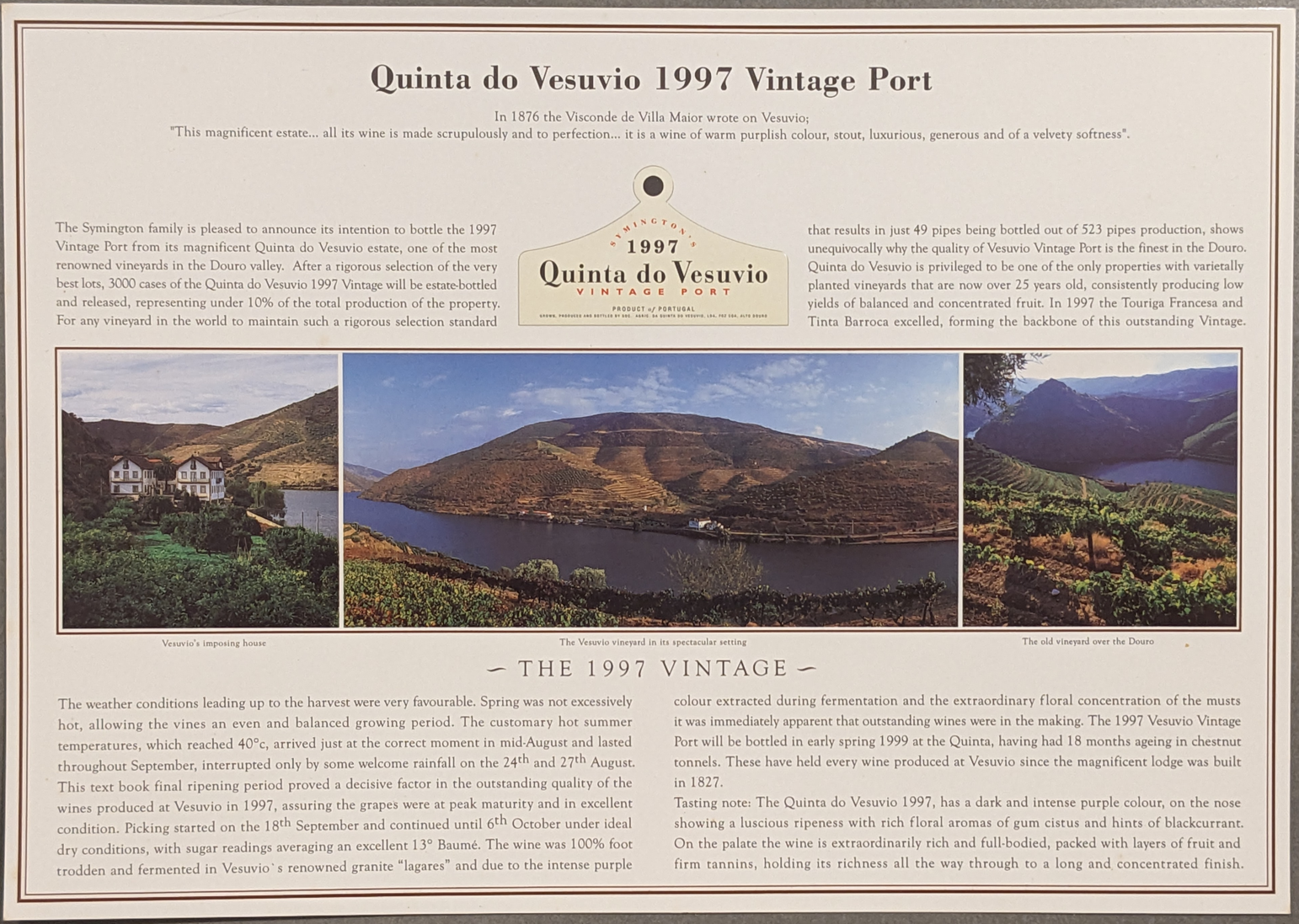
A plasticised A4 enclosure, in a box of Vesuvio 1997, wrote:Quinta do Vesuvio 1997 Vintage Port
In 1876 the Visconde de Villa Maior wrote on Vesuvio;
"This magnificent estate… all its wine is made scrupulously and to perfection… it is a wine of warm purplish colour, Stout, luxurious, generous and of a velvety softness".
The Symington family is pleased to announce its intention to bottle the 1997 Vintage Port from its magnificent Quinta do Vesuvio estate, one of the most renowned vineyards in the Douro valley. After a rigorous selection of the very best lots, 3000 cases of the Quinta do Vesuvio 1997 Vintage will be estate-bottled and released, representing under 10% of the total production of the property. For any vineyard in the world to maintain such a rigorous selection standard that results in just 49 pipes being bottled out of 523 pipes production, shows unequivocally why the quality of Vesuvio Vintage Port is the finest in the Douro. Quinta do Vesuvio is privileged to be one of the only properties with varietally planted vineyards that are now over 25 years old, consistently producing low yields of balanced and concentrated fruit. In 1997 the Touriga Francesa and Tinta Barroca excelled, forming the backbone of this outstanding Vintage.
— The 1997 Vintage —
The weather conditions leading up to the harvest were very favourable. Spring was not excessively hot, allowing the vines an even and balanced growing period. The customary hot summer temperatures, which reached 40°C, arrived just at the correct moment in mid-August and lasted throughout September, interrupted only by some welcome rainfall on the 24th and 27th August. This text book final ripening period proved a decisive factor in the outstanding quality of the wines produced at Vesuvio in 1997, assuring the grapes were at peak maturity and in excellent condition. Picking started on the 18th September and continued until 6th October under ideal dry conditions, with sugar readings averaging an excellent 13° Baumé. The wine was 100% foot trodden and fermented in Vesuvio`s renowned granite “lagares” and due to the intense purple
colour extracted during fermentation and the extraordinary floral concentration of the musts it was immediately apparent that outstanding wines were in the making. The 1997 Vesuvio Vintage Port will be bottled in early spring 1999 at the Quinta. having had 18 months ageing in chestnut tonnels. These have held every wine produced at Vesuvio since the magnificent lodge was built in 1827.
Tasting note: The Quinta do Vesuvio 1997, has a dark and intense purple colour, on the nose showing a luscious ripeness with rich floral aromas of gum cistus and hints of blackcurrant. On the palate the wine is extraordinarily rich and full-bodied, packed with layers of fruit and firm tannins. holding its richness all the way through to a long and concentrated finish.
-
Alex Bridgeman
- Croft 1945
- Posts: 16685
- Joined: 12:41 Mon 25 Jun 2007
- Location: Berkshire, UK
Re: Port-box enclosures
In Majestic a few days ago I came across a Quevedo Special Reserve Tawny - Victoria Edition. I bought one (a 50cl mini-ships decanter which will make a nice half bottle decanter in the future).
The special box comes with some blurb on the back.
The special box comes with some blurb on the back.
- The special edition cardboard box
- IMG_7696.jpeg (95.9 KiB) Viewed 33268 times
- The back of the box
- IMG_7698.jpeg (145.92 KiB) Viewed 33268 times
On the back of the Victoria edition of Quevedo Special Reserve Tawny found in Majestic Wine Shops, Quevedo wrote:Victoria PortoSPECIAL RESERVE AGED TAWNY
Did you know our great-grandfather planted his first vineyards right around the time the Douro Railway started in 1887? That railway was a game changer - it connected the Douro Valley to Porto, making it much easier to share our wine with the world.
Before that, everything had to travel by boat! Every sip of VICTORIA is like savoring a piece of history. You'll experience a rich, velvety texture and complex flavors perfected over time. It's a true tribute to the hard work and dedication behind its creation.
Whether you're sharing a glass with friends or enjoying a quiet evening, every moment feels special. Here's to celebrating those unforgettable moments and the stories that make them!
Top 2025: Quevedo 1972 Colheita, b.2024. Just as good as Niepoort 1900!
2026: DR Very Old White, Graham Stone Terraces 2011, Quevedo Branco 1986 b.2026
2026: DR Very Old White, Graham Stone Terraces 2011, Quevedo Branco 1986 b.2026
Re: Port-box enclosures
That looks nice.
-
Alex Bridgeman
- Croft 1945
- Posts: 16685
- Joined: 12:41 Mon 25 Jun 2007
- Location: Berkshire, UK
Re: Port-box enclosures
In 2011/12, the Symingtons filled 1,000 bottles and 10 jeroboams with 1952 Single Harvest Tawny in commemoration of the diamond jubilee of Queen Elizabeth. These bottles were available in the UK exclusively from Berry Brothers and in Portugal.
Bottles were mostly in the format of singles in a Royal Blue pressed card case, although a small number of oak 3 bottle case mades were also available.
The single bottle boxes had considerable writing on them.
Bottles were mostly in the format of singles in a Royal Blue pressed card case, although a small number of oak 3 bottle case mades were also available.
The single bottle boxes had considerable writing on them.
- Pressed card case
- IMG_7788.jpeg (146.13 KiB) Viewed 32953 times
- Empty bottle in its box
- IMG_7789.jpeg (128.4 KiB) Viewed 32953 times
- Inside front cover
- IMG_7790.jpeg (116.63 KiB) Viewed 32953 times
- Writing behind the bottle
- IMG_7791.jpeg (148.54 KiB) Viewed 32953 times
- Front label
- IMG_7792.jpeg (174.31 KiB) Viewed 32953 times
- Back label
- IMG_7795.jpeg (200.05 KiB) Viewed 32953 times
Symington Family Estates wrote: W. & J.
GRAHAM'S PORT
ESTABLISHED 1820
IN CELEBRATION OF THE QUEEN'S DIAMOND JUBILEE
W &J Graham & Co and Berry Bros. & Rudd are proud to mark the 60th anniversary of the Queen's accession to the throne with this commemorative limited bottling of Graham's 1952 finest old tawny Port.
For six decades, this Port has gently aged in seasoned oak casks, quietly bearing witness to Her Majesty's inspirational and enduring reign. Generations of Symington family winemakers, owners of Graham's, have accompanied the development of this venerable wine, regularly checking and assuring its progress on the long journey towards an ideal stage of refinement.
Port has always been a wine associated with longevity, given its ability to age over very long periods, and W &J Graham & Co, together with Berry Bros. & Rudd, believe that this 1952 Port appropriately expresses and celebrates the Queen's Diamond Jubilee.
BERRY BROS & RUDD
WINE & SPIRIT MERCHANTS
3 ST JAMES'S STREET LONDON SWI
Striking mahogany, with hints of amber at its rim, the wine has an extraordinary aromatic intensity, redolent of old libraries, autumnal bonfires and distant poetry.
The palate is profound and majestic, astonishingly intense and powerful, regal in its complexity, a timeless elixir.
Notes of molasses, dried apricot, fig and clove, dance across the palate elegant and symphonic in their structure, dignified and profound. Orange zest freshness and finely-wrought tannins underwrite structural harmony
with the long finish indulging a gentle nostalgia and a real sense of worth.
Simon Field MW
Berrys' Port Buyer
THIS RARE BOTTLING OF WOOD MATURED COLHEITA PORT WINE WAS SLOWLY MELLOWED TO A PEAK OF MATURITY IN SEASONED OAK CASKS AT GRAHAM'S PORT LODGE, BUILT CLOSE TO THE ESTUARY OF THE DOURO RIVER IN 1890.
To commemorate the Diamond Jubilee of Her Majesty Queen Elizabeth II, W&J Graham & Co are pleased to offer, exclusively through Berry Bros. & Rudd, this exceptionally fine old tawny Port produced in 1952, the year the Queen ascended the throne.
The Symington family, owners of this long established Port house, frequenty taste the wines in the lodge to assess their progress. During one of these regular tastngs, they decided to take some samples from the six remaining casks of the 1952 Port.
Over many years, this remarkable old tawny has been developing magnificently and the family agreed, together with their long-time customer and friends, Berry Bros. & Rudd, to bottle the Port as a fitting tribute to the Queen in her Diamond Jubilee Year:
Graham's are offering this memorable old tawny Port in individually numbered bottles, and believe that this celebratory Port is a most appropriate wine with which to honour 60 years of Her Majesty's reign.
Top 2025: Quevedo 1972 Colheita, b.2024. Just as good as Niepoort 1900!
2026: DR Very Old White, Graham Stone Terraces 2011, Quevedo Branco 1986 b.2026
2026: DR Very Old White, Graham Stone Terraces 2011, Quevedo Branco 1986 b.2026
-
Andy Velebil
- Quinta do Vesuvio 1994
- Posts: 3118
- Joined: 21:16 Mon 25 Jun 2007
- Location: Los Angeles, Ca USA
- Contact:
Re: Port-box enclosures
Was lucky to have had that 1952 a number of times. Absolutely fabulous Colheita!
I too have an empty of it still.
I too have an empty of it still.

Re: Port-box enclosures
Enclosure from a Dow 1977 Magnum in wooden box, "MM Millenium Selection"
- IMG_3885c.JPG (1.22 MiB) Viewed 32571 times
- 13c45379-4c44-474b-a451-8e4fdfdb20cc.jpg (157.99 KiB) Viewed 32571 times
-
Alex Bridgeman
- Croft 1945
- Posts: 16685
- Joined: 12:41 Mon 25 Jun 2007
- Location: Berkshire, UK
Re: Port-box enclosures
How lovely to think of Dow 1977 as being the perfect point for drinking at the age of 22...
Top 2025: Quevedo 1972 Colheita, b.2024. Just as good as Niepoort 1900!
2026: DR Very Old White, Graham Stone Terraces 2011, Quevedo Branco 1986 b.2026
2026: DR Very Old White, Graham Stone Terraces 2011, Quevedo Branco 1986 b.2026
-
Andy Velebil
- Quinta do Vesuvio 1994
- Posts: 3118
- Joined: 21:16 Mon 25 Jun 2007
- Location: Los Angeles, Ca USA
- Contact:
Re: Port-box enclosures
Was thinking the same when I read that. But guess better young than never?Alex Bridgeman wrote:How lovely to think of Dow 1977 as being the perfect point for drinking at the age of 22...
-
Christopher
- Graham’s The Tawny
- Posts: 466
- Joined: 13:24 Thu 17 Jan 2008
- Location: London
Re: Port-box enclosures
Great idea
But I wonder whether it needs an index approach possibly linked to the vintage tasting notes? Not sure how feasible that is
But I wonder whether it needs an index approach possibly linked to the vintage tasting notes? Not sure how feasible that is
-
Alex Bridgeman
- Croft 1945
- Posts: 16685
- Joined: 12:41 Mon 25 Jun 2007
- Location: Berkshire, UK
Re: Port-box enclosures
That’s a very good suggestion. It would need a new section of the forum, similar in structure to the Tasting Notes, but then we could build an index around it.Christopher wrote: ↑20:51 Tue 06 Jan 2026 Great idea
But I wonder whether it needs an index approach possibly linked to the vintage tasting notes? Not sure how feasible that is
Top 2025: Quevedo 1972 Colheita, b.2024. Just as good as Niepoort 1900!
2026: DR Very Old White, Graham Stone Terraces 2011, Quevedo Branco 1986 b.2026
2026: DR Very Old White, Graham Stone Terraces 2011, Quevedo Branco 1986 b.2026
-
Alex Bridgeman
- Croft 1945
- Posts: 16685
- Joined: 12:41 Mon 25 Jun 2007
- Location: Berkshire, UK
Re: Port-box enclosures
This same pamphlet was included in an OWC of the 1995 Vesúvio vintage.
jdaw1 wrote: ↑22:16 Wed 17 Dec 2025 Wooden boxes of six of Vesuvio 1996, and of Vesuvio 1997, each contained identical pamphlets.
Vesuvio pamphlet, enclosed in 1996 and 1997 Vintages, wrote:A Pre-eminent Douro Quinta
In the austere and primitive beauty of Portugal’s Port-growing Upper Douro valley the Quinta do Vesuvio stands alone both in terms of remoteness and sheer grandeur. This enormous property commands a spectacular site on the south bank of the River Douro, half way between the two ancient castles of Numão and Lavandeira that dominated the river crossing in the 11th and 12th centuries. The Quinta consists of 408 hectares (1.008 acres) bound by a 15 kilometre perimeter of which 5 kilometres are on the River Douro.
The Viscount of Villa Maior aptly summed up the considerable proportions of Vesuvio when he wrote in his authoritative book “The Illustrated Douro” (published in 1876); “This brief description will give an idea of the extraordinary and intricate topography of the Quinta do Vesuvio. We may count there seven hilltops, thirty one valleys and glens, separated by thirty seven elevations more or less extensive and prominent”.
Although historical records mention Vesuvio as early as 1565 it was primarily under the auspices of the Douro’s redoubtable widow, Dona Antónia Adelaide Ferreira, that this vineyard estate acquired its legendary reputation. The estate’s industrious founder was her husband who from 1820 began the ambitious task of planting the vineyard. This gargantuan enterprise involving the shaping and construction of terraces on the intractable slopes and the planting of hundreds of thousands of vines took his legions of workers thirteen years to complete. Following the founder’s death, his widow continued to develop the property which under her able management became the show-piece quinta of the Douro. At Vesuvio she built one of the Douro’s largest wineries, containing eight granite ‘lagares’ (treading tanks) each capable of holding 25 pipes (i pipe: 550 litres). In 1876 the Viscount of Villa Maior was to write of Vesuvio and its wines; “All this wine is made scrupulously and to perfection. When put into the vats it has an uniform composition: it is a wine of warm purplish colour, stout, luscious, generous and of a velvety softness, having that pungency which is necessary to ensure the ultimate qualities that the wine of the Douro can only acquire after a lapse of many years”.
The Symington Family and Vesuvio
In 1989 Quinta do Vesuvio was purchased by the Symington family whose involvement in the growing, production and shipping of Port began more than a century ago. The family decided from the outset to preserve the traditional character of the quinta especially with regard to the vinification process where the time honoured method of treading the grapes by foot has been retained. Some technological innovations have been introduced principally in the form of a cooling system to control fermentation in this ancient wine making method.
A substantial investment was the planting of a new vineyard involving 30.000 vines planted in 1990 and a further 50.000 planted in 1991 bringing the overall number on the property to 268.360, occupying 67 hectares of the total of 408.
In view of the outstanding quality of the wine it was decided to offer Vesuvio exclusively as a single Quinta Vintage Port. Only about 50 pipes (36.000 bottles) are bottled each year although the production of the property is much greater and this exemplifies the family’s steadfast policy of releasing none but the very finest wines from the Quinta.
Winemaking at Vesuvio
Some of the greatest Vintage Ports of the 19th and 20th centuries were made by the ancient method of treading the grapes in the traditional stone tanks called ‘lagares’. However this biblical system entails certain risks, particularly with regard to temperature control. Since Quinta do Vesuvio is located in 'the severe and parched Upper Douro, it is subject to exceptionally hot weather during the vintage.
Peter Symington, the member of the family who is responsible for the winemaking, devised an innovative cooling mechanism for the lagares. This consists of stainless steel piping that is submerged in the lagares and through which pre-chilled water is circulated to keep the fermentation temperature within the determined limits. The combination of adopting the best of the ancient ways with modern technology has resulted in the production of quite exceptional wines.
Profile of Quinta do Vesuvio
Vineyard Classification
The quinta has the maximum ‘A’ grade classification. Port vineyards are classified from A down to F in accordance with a points system awarded on the basis of factors such as; location, aspect, soil, microclimate, grape varieties, age of vines, productivity, etc.
Total Area of the Property
408 hectares (1.008 acres) of which 67 hectares are under vine. The quinta also produces olive oil, almonds, honey and oranges.
Location
Upper Douro valley in north-eastern Portugal, 120 kilometres east of Oporto and 45 kilometres from the Spanish border. Set in the prime wine growing area of the demarcated Port region (the oldest demarcated wine region in the world, the limits of which were set in 1756).
Vintage Port Production
The estate’s production is offered exclusively as single Quinta Vintage Port. Total annual production of the property is at present approximately 200 ‘pipes’ (x pipe: 550 litres), and will rise gradually as new plantings mature. Only the very best wines are bottled as Quinta do Vesuvio Vintage Port.
Grape Varieties
The four principal Port grape varieties are planted in roughly equal proportions and account for 84.% of the estate's total. They are as follows:-
Touriga Nacional (18.5%)
Widely recognised as the classic port grape it has great depth of fruit, intense aroma, deep colour and high tannin content. Very low yielding but contributes great character to the blend.
Tinta Roriz (21%)
This has rich fleshy fruit, high sugar content and provides good colour and succulcnce in a blend. It is the Tempranillo of Rioja and Tinto del Pais of Ribera del Duero in neighbouring Spain.
Touriga Francesca (22%)
The major contributor to the ‘nose’ of the blend, It has a marvellous aroma, being both flowery and fruity.
Tinta Barroca (22.5%)
Big and meaty, with a high sugar content, and also high in tannin. An important variety for the overall structure of the blend.
Top 2025: Quevedo 1972 Colheita, b.2024. Just as good as Niepoort 1900!
2026: DR Very Old White, Graham Stone Terraces 2011, Quevedo Branco 1986 b.2026
2026: DR Very Old White, Graham Stone Terraces 2011, Quevedo Branco 1986 b.2026
-
Alex Bridgeman
- Croft 1945
- Posts: 16685
- Joined: 12:41 Mon 25 Jun 2007
- Location: Berkshire, UK
Re: Port-box enclosures
A single bottle box of Graham Stone Terraces 2011 contained a small booklet.
The text of the first page reads:
- Front cover
- IMG_8213.jpeg (198.07 KiB) Viewed 24405 times
- First page
- IMG_8214.jpeg (144 KiB) Viewed 24405 times
- Middle pages
- IMG_8215.jpeg (161.35 KiB) Viewed 24405 times
- Back page
- IMG_8216.jpeg (144.56 KiB) Viewed 24405 times
- Back cover
- IMG_8217.jpeg (159.46 KiB) Viewed 24405 times
The text of the first page reads:
2011 VINTAGE PORT
The Vintage of 2011 is one that our generation will best remember. Conditions for ripening and harvesting were near perfect and almost unprecedented in our experience.
The Malvedos vineyard has been at the heart of Graham's Vintage Ports since 1890. In 2011, our family resolved for the first time to make a very special Port from grapes picked by hand on two small stone-terraced vineyards, first established in the 18th century.
The Ports from these stone-terraced vineyards, called 'Port Arthur' and 'Vinha dos Cardenhos' have always been prized at Malvedos for their exceptional quality and distinctive characteristics which make them markedly different to the Quinta's other wines.
Graham's The Stone Terraces 201I Vintage Port is a tribute to the men and women who laboured to build the stone walls that support these vines. The outstanding quality of this wine is a homage to their memory.
THE SYMINGTON FAMILY.
Top 2025: Quevedo 1972 Colheita, b.2024. Just as good as Niepoort 1900!
2026: DR Very Old White, Graham Stone Terraces 2011, Quevedo Branco 1986 b.2026
2026: DR Very Old White, Graham Stone Terraces 2011, Quevedo Branco 1986 b.2026
-
Glenn E.
- Cálem Quinta da Foz 1970
- Posts: 4561
- Joined: 21:27 Wed 09 Jul 2008
- Location: Seattle, WA, USA
Re: Port-box enclosures
I have similar booklets from 2015 and 2016. I have not been able to confirm 2017 or 2021, but I suspect both exist. (My storage of these wood boxes is... haphazard.)Alex Bridgeman wrote: ↑12:46 Sun 08 Mar 2026 A single bottle box of Graham Stone Terraces 2011 contained a small booklet.
Text from 2015 first page:
Text from 2016 first page:We believe that the 2015 Stone Terraces will age superbly as a remarkable Vintage Port of extraordinary elegance and complexity.
The Malvedos vineyard has been at the heart of Graham's Vintage Ports since 1890. In 2011, our family resolved for the first time to make a very special Port from grapes picked by hand on two small stone-tarraced vineyards, first established in the 18th century.
The Ports from these stone-terraced vineyards, called 'Port Arthur' and 'Vinha dos Cardenhos' have always been prized at Malvedos for their exceptional quality and distinctive characteristics which make them markedly different to the quinta's other wines.
Graham's The Stone Terraces 2015 Vintage Port is a tribute to the men and women who laboured to build the stone walls that support these vines. The outstanding quality of this wine is a homage to their memory.
The Symington Family
2016 is an outstanding Vintage in which all the right conditions aligned perfectly in the vineyards to deliver exceptionally balanced, well-toned wines of great structure.
The Malvedos vineyard has been at the heart of Graham's Vintage Ports since 1890. For only the third time, our family deiced to make a very limited quantity of Port from the grapes picked by hand on two small drystone walled vineyard terraces, dating from the 18th century.
The Ports from these stone-terraced vineyards, called 'Port Arthur' and 'Vinha dos Cardenhos' have always been prized at Malvedos for their exceptional quality and distinctive characteristics which make them markedly different to the Quinta's other wines.
Graham's The Stone Terraces 2016 Vintage Port is a tribute to the men and women who laboured to build the stone walls that support these vines. The outstanding quality of this wine is a homage to their memory.
The Symington Family
Glenn Elliott
-
Glenn E.
- Cálem Quinta da Foz 1970
- Posts: 4561
- Joined: 21:27 Wed 09 Jul 2008
- Location: Seattle, WA, USA
Re: Port-box enclosures
2017 Quinta do Vesuvio Capela has a similar booklet, albeit the cover is red.
Which implies that I should probably double-check all of these super cuvees that I own. Unfortunately I don't have the time to do that right at this moment.
Which implies that I should probably double-check all of these super cuvees that I own. Unfortunately I don't have the time to do that right at this moment.
Glenn Elliott