jdaw1 wrote: ↑23:36 Tue 16 Dec 2025
I recall a
physicist remarking that thermometers are difficult to calibrate.
What do people use, and do they know it to be accurate? Are mercury thermometers the most likely to be stably accurate? Etc.
I do love a good deep dive.
Zak's top
5 4 Thermometers to buy your loved ones this Christmas that are common place in an quantum computing facility.
4.
Room temperature and humidity with in built clock!
Pros:
Cons:
- Low accuracy and precision
- Not going to impress your other half with it's clinical appearance
3.
PT100
A thin wire of platinum which is 100 Ohms at 0 degC.
Pros:
- Simply measure resistance of a metal and compare to calibrated look up table* from -50 to 200degC.
- Small footprint for sensor
- Works as a small fishing rod should you need it.
Cons:
- Doesn't account for non-idealities of pure metals which means it's off by 25degC at -200degC! **
Switching units to Kelvin, 0 K = -273.15degC. Sorry Glenn, I can't bring myself to even entertain Fahrenheit.
2.
Silicon diode thermocouple
Uses the magic of semiconductor physics to measure the temperature. Here's an example of it in action when I was testing some components. Look at all that precision!

- Media.jpeg (60.91 KiB) Viewed 28171 times
Pros:
- Voltage measurement and calibrated lookup table from 1 K to 400 K.
- Consistent performance and temperature response at low temperatures
- Simple friends will be impressed when you say that you have a silicon diode thermocouple
Cons:
- Thermal load of equipment ****
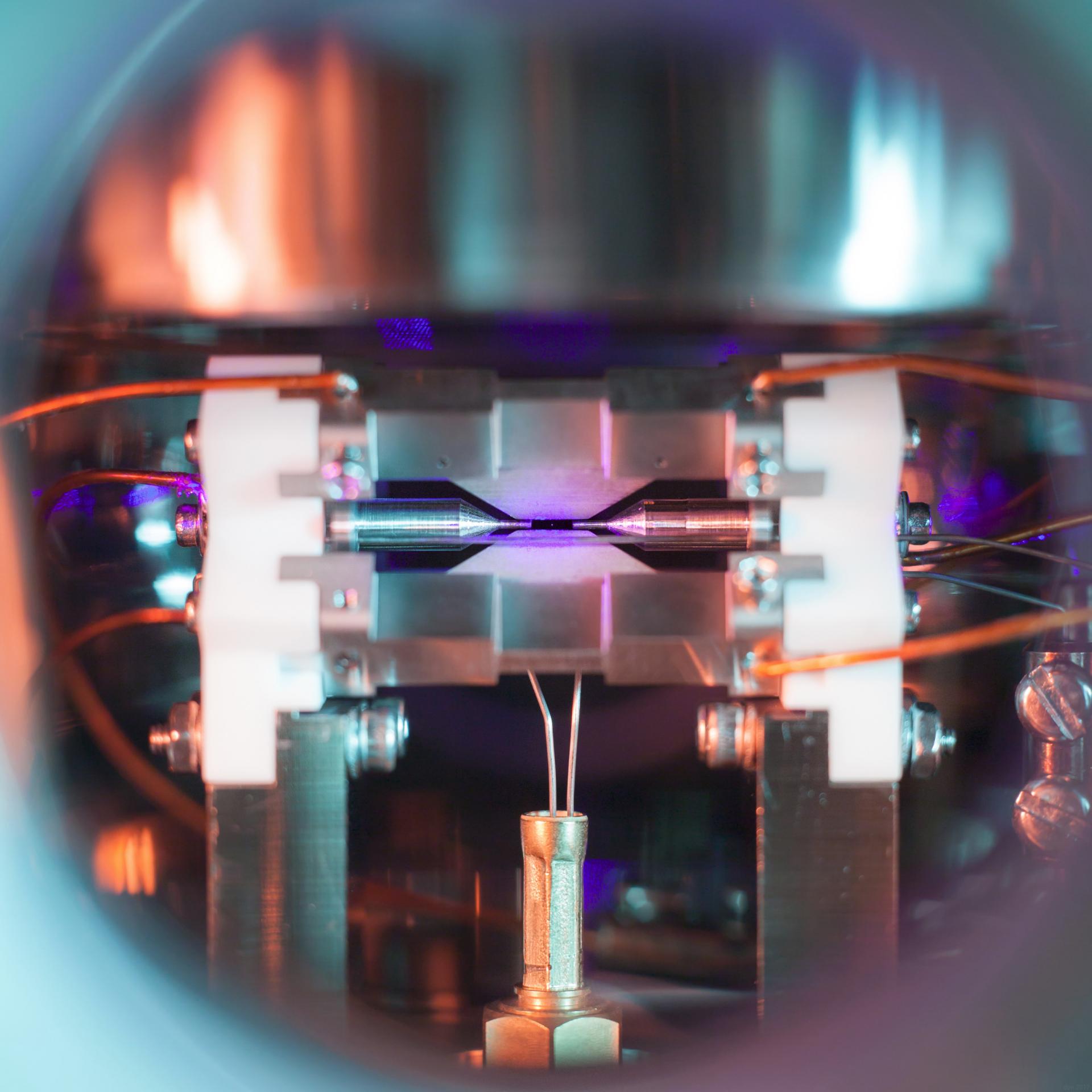
1. A single ion (take an atom, remove and electron, trap it in a pringled electric field. It's that simple)
Here's a picture of a trapped ion taken with a digital camera! Kinda nuts.
- _MG_1200_compressed.jpg (208.64 KiB) Viewed 28171 times
Pros:
- Extreme thermal isolation from environment
- Able to measure to 50uK (yes, 50 millionths of a degree above absolute zero)
- When you explain it to your parents they'll zone out and leave you alone
Cons:
- Once you've measured it, it heats up to ~1mK *****. But at least you know what is was
- >£250,000 brand new just to measure temperature - nothing else - second hand might be cheaper
- Not really measuring temperature, measuring energy ******
On a more serious note, what Martin suggested seems good.
* Calibration is a very long topic to cover. Taking Martin's example of calibration.
This is calibrated to either one or two points. i.e. it's guaranteed (to some spec) to match at that temperature. But outside that temperature what happens?
When we consider a mercury thermometer, it uses the thermal expansion of mercury to give the temperature. When it heats up, its expands, raising the level on the thermometer. The problem is that this rate of expansion as a function of temperature is not constant i.e. at 0degC say my mercury thermometer rises 1mm for a 1 Celsius change in temperature. At 100degC that would only be 0.994mm rise. Tragic.
The look up table improves by provides the calibration across many temperatures which therefore accounts for the fact that this moves. A must have if your loved one truly cares about temperature.
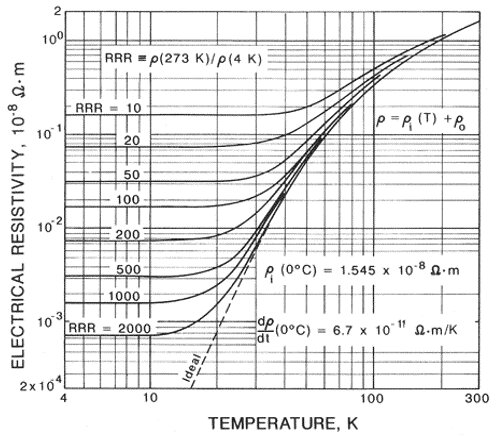
** A true bain of my existence. Impurities. If you had a pure conductor, technically, when the temperature drops to 0 K (-273.15degC or coldest possible temperature ***) its resistance would also drop to zero. Because of impurities that doesn't happen. We measure this with a property called residual resistivity ratio (RRR) which is a ratio of the room temperature resistivity to that at steady-state low temperature (typically 4K). See the below example for copper.
- Temperature-dependence-of-the-electrical-resistivity-of-copper-for-different-values-of_W640.jpg (53.67 KiB) Viewed 28171 times
. As impurities are hard to control, this means it doesn't make a repeatable thermometer. Your father-in-law will therefore frown at you in disappointment.
***One for a future topic. You can
technically get negative temperature.
**** Measurements are hard. One of the key principles is that if you're measuring something, the actual act of measurement shouldn't effect the result. Taking this thermocouples for example. These are connected with some wires to a multimeter at room temperature. This means they bring some heat load into the system and heat up what you're trying to measure. Embarrassing right?
***** Quantum measurements are even harder. The act of measuring the "temperature" destroys the that state so can't use that for future work. There's such things as quantum non-destructive measurements where you instead measure something else but that's another story.
****** Quantum comes from the concept of quantisation. Long as short of it is, we view lots of things as continuous. Take a pendulum for example swinging backwards are forwards. You could always imagine that you could keep swinging it a smaller and smaller amount. Problem is that at very low energies, that is not true and you realise that it is quantised i.e. there is one finite level of swinging and the next finite level with nothing in between. This means so far we've just measured energy. Temperature however is a statistical quantity so you'd need a ensemble. We can cheat however and approximate temperature to energy. A much better option would be to use a Bose Einstein Condensate. Nope. Not covering it.
And finally, I did originally include a thermal camera for the list. It was horrifically obtuse to use and there isn't a pit deep enough to throw it down.

